Heritage · 7 min read
The language of kente, and why the pattern matters
Kente is a written language as much as a textile. A short guide to the most common patterns, what they mean, and how to choose one for a wedding or naming ceremony.
· Nsaano Atelier
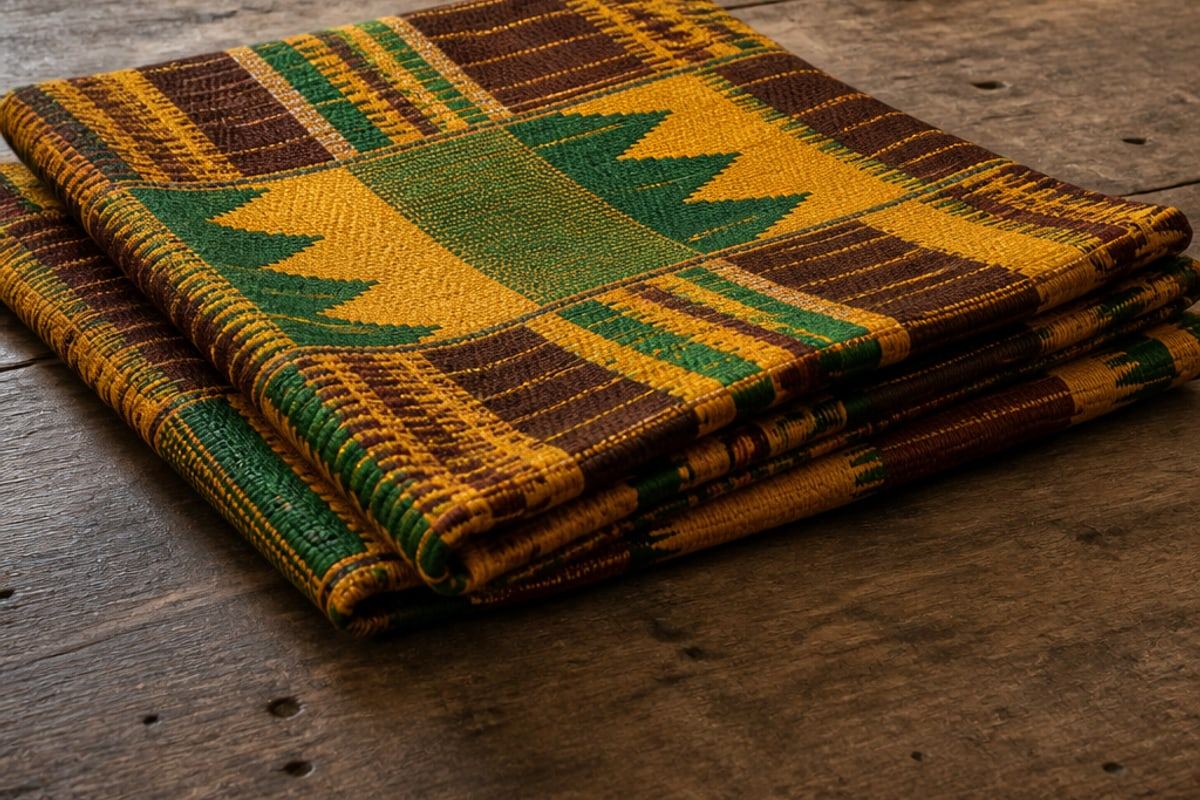
Kente is woven in narrow strips on a horizontal loom, then cut and hand-sewn edge to edge into a single cloth. What looks like decoration is closer to writing. Each pattern has a name, and most names carry a proverb behind them.
That is why we start a kente commission with the occasion, not a moodboard. You are not picking a print. You are choosing what the cloth will say in the room.
How the cloth is made
Asante and Ewe weavers in Ghana work on a narrow loom, often four fingers wide. Colour is built into the cloth as it is woven, not printed on afterwards. The weaver sets the warp, then lays in the weft so geometry, proverb, and colour arrive together.
The strips are joined by hand. That seam is part of the cloth, not a shortcut. A well-joined kente hangs as one plane. A rushed join shows as a ridge the first time the piece is worn.
Machine-printed fabric with a kente motif skips all of that. It can be handsome. It is still a picture of kente, not kente.
A few patterns you will meet
There are hundreds. These three come up most often in wedding, naming, and ceremonial briefs.
Adwinasa translates roughly as "all motifs are used up": the weaver has exhausted their repertoire in a single cloth. Historically it was reserved for royalty. It is still the pattern people reach for when they want a piece to look unmistakably ceremonial, a stole, agbada trim, or bridal panel that should read as the full vocabulary of the bench.
Sika Futuro, "gold dust", references the currency of the Asante kingdom. It reads as prosperity rather than wealth for its own sake: continuity, a household that is provided for, a venture that is meant to last. Families often choose it for a fiftieth birthday, a first house, or a wedding where gold already sits in the jewellery.
Emaa Da, "it has not happened before", marks something unprecedented: a first marriage in a family, a graduation nobody expected, a new venture. It is the pattern we suggest when the brief is "this has not been done in our house before", and the cloth should say so without a speech.
If your family already owns a cloth, bring that name. A pattern inherited from a grandmother will always sit better than one we invent for the photograph.
Colour carries meaning too
Gold speaks to status and continuity. Green is planting, growth, and fertility. Black is not mourning in the way a European reader might assume; it is maturity and spiritual intensity, often used for ancestral occasions. Blue is peace and harmony. Red is political and emotional intensity, and is used carefully.
None of these are rules you fail. They are a vocabulary. A green and gold Adwinasa for a naming ceremony is a different sentence from a black and gold Adwinasa for a memorial. Same pattern, different weight.
When a client sends us a palette they like, we still ask what the day is for. Colour without the occasion is interior design. Colour with the occasion is the cloth doing its job.
Choosing kente for a commission
When a client asks us for a kente-trimmed agbada or a bridal kaba, we start with who will be in the room. A naming ceremony, a fiftieth birthday, and a wedding all point to different patterns, and the family sometimes already has a cloth with meaning attached to it.
If you are ordering from outside Ghana and are unsure, send us the occasion and who will be there. We will suggest two or three patterns, explain what each one says, and weave a sample before committing your cloth. Photographs go out at cloth, cut, stand, and pack, so you see the pattern on the actual strips before the tailor closes the garment.
Lead time is four to six weeks. Kente is not cut from a printed roll. The weaver has to make the strips, and the same tailor who cuts the commission is the tailor who finishes it.
If you want to handle the cloth first, the kente collection is the shop window: strips and stoles, not a picture of the weave. For a garment, start with the occasion: who will be in the room, and what the cloth should say.
On authenticity
Machine-printed fabric with a kente motif is not kente. It is a picture of kente. Everything we trim with is handwoven on a loom by weavers we name, and the strips are joined by hand. It costs more and takes longer, and it is the reason the cloth holds its structure for decades.
That distinction is the one we will not blur. Adinkra, batik, and indigo sit on daywear and occasion pieces so a garment can read African atelier without becoming costume. Ceremonial trim and stoles are the place we insist on the loom. If a brief asks for "kente print", we will say so, and offer the woven cloth instead.